


处理错误
🌐 Dealing with Errors
引用自《龙书》(https://www.amazon.com/Compilers-Principles-Techniques-Tools-2nd/dp/0321486811)
🌐 Quoting from the Dragon Book
大多数编程语言规范并没有描述编译器应如何应对错误;错误处理由编译器设计者决定。 从一开始就规划错误处理可以既简化编译器的结构,又提高其错误处理能力。
一个完全可恢复的解析器无论我们输入什么,都能构建抽象语法树(AST)。对于像代码检查工具或格式化工具这样的工具,人们希望有一个完全可恢复的解析器,这样我们就可以对程序的部分内容进行操作。
🌐 A fully recoverable parser can construct an AST no matter what we throw at it. For tools such as linter or formatter, one would wish for a fully recoverable parser so we can act on part of the program.
如果有任何语法不匹配,恐慌解析器会中止,而部分可恢复的解析器则可以从确定性语法中恢复。
🌐 A panicking parser will abort if there is any grammar mismatch, and a partially recoverable parser will recover from deterministic grammars.
例如,给定一个语法不正确的 while 语句 while true {},我们知道它缺少圆括号,并且它唯一可能有的标点符号就是圆括号,所以我们仍然可以返回一个有效的 AST,并指出它缺少的括号。
🌐 For example, given a grammatically incorrect while statement while true {}, we know it is missing round brackets, and the only punctuation it can have are round brackets, so we can still return a valid AST and indicate its missing brackets.
大多数现有的 JavaScript 解析器都是部分可恢复的,所以我们也将采用同样的方法,构建一个部分可恢复的解析器。
🌐 Most JavaScript parsers out there are partially recoverable, so we'll do the same and build a partially recoverable parser.
INFO
Biome 解析器是一个完全可恢复的解析器。
Rust 有 Result 类型用于返回和传播错误。结合 ? 语法,解析函数将保持简洁明了。
🌐 Rust has the Result type for returning and propagating errors. In conjunction with the ? syntax, the parse functions will remain simple and clean.
通常会封装 Result 类型,这样我们以后可以替换错误:
🌐 It is common to wrap the Result type so we can replace the error later:
pub type Result<T> = std::result::Result<T, ()>;我们的解析函数将返回一个结果,例如:
🌐 Our parse functions will return a Result, for example:
pub fn parse_binding_pattern(&mut self, ctx: Context) -> Result<BindingPattern<'a>> {
    match self.cur_kind() {
        Kind::LCurly => self.parse_object_binding_pattern(ctx),
        Kind::LBrack => self.parse_array_binding_pattern(ctx),
        kind if kind.is_binding_identifier() => {
          // ... code omitted
        }
        _ => Err(()),
    }
}
我们可以添加一个 expect 函数,如果当前标记与语法不匹配,则返回错误:
🌐 We can add an expect function for returning an error if the current token does not match the grammar:
/// Expect a `Kind` or return error
pub fn expect(&mut self, kind: Kind) -> Result<()> {
    if !self.at(kind) {
        return Err(())
    }
    self.advance();
    Ok(())
}
并按如下方式使用:
🌐 And use it as such:
pub fn parse_paren_expression(&mut self, ctx: Context) -> Result<Expression> {
    self.expect(Kind::LParen)?;
    let expression = self.parse_expression(ctx)?;
    self.expect(Kind::RParen)?;
    Ok(expression)
}
INFO
为了完整性,当词法分析时遇到意外的 char 时,词法分析器函数 read_next_token 也应该返回 Result。
🌐 For completeness, the lexer function read_next_token should also return Result when an unexpected char is found when lexing.
“Error”特性
🌐 The Error Trait
要返回特定错误,我们需要填写 Result 的 Err 部分:
🌐 To return specific errors, we need to fill in the Err part of Result:
pub type Result<T> = std::result::Result<T, SyntaxError>;
                                            ^^^^^^^^^^^
#[derive(Debug)]
pub enum SyntaxError {
    UnexpectedToken(String),
    AutoSemicolonInsertion(String),
    UnterminatedMultiLineComment(String),
}
我们称它为 SyntaxError,因为 ECMAScript 规范语法部分定义的所有“早期错误”都是语法错误。
🌐 We call it SyntaxError because all "early error"s defined in the grammar section of the ECMAScript specification are syntax errors.
为了将其制作成一个合适的 Error,它需要实现 Error Trait。为了让代码更清晰,我们可以使用 thiserror crate 中的宏:
🌐 To make this a proper Error, it needs to implement the Error Trait. For cleaner code, we can use macros from the thiserror crate:
#[derive(Debug, Error)]
pub enum SyntaxError {
    #[error("Unexpected Token")]
    UnexpectedToken,

    #[error("Expected a semicolon or an implicit semicolon after a statement, but found none")]
    AutoSemicolonInsertion,

    #[error("Unterminated multi-line comment")]
    UnterminatedMultiLineComment,
}
然后我们可以添加一个 expect 辅助函数,如果令牌不匹配就抛出错误:
🌐 We can then add an expect helper function for throwing an error if the token does not match:
/// Expect a `Kind` or return error
pub fn expect(&mut self, kind: Kind) -> Result<()> {
    if self.at(kind) {
        return Err(SyntaxError::UnexpectedToken);
    }
    self.advance(kind);
    Ok(())
}
“parse_debugger_statement”现在可以使用“expect”功能进行正确的错误管理:
🌐 The parse_debugger_statement can now use the expect function for proper error management:
fn parse_debugger_statement(&mut self) -> Result<Statement> {
    let node = self.start_node();
    self.expect(Kind::Debugger)?;
    Ok(Statement::DebuggerStatement {
        node: self.finish_node(node),
    })
}
注意 expect 之后的 ?,它是一种语法糖,称为“问号操作符”,用于在 expect 函数返回 Err 时让函数提前返回。
🌐 Notice the ? after the expect, it is a syntactic sugar called the "question mark operator" for making the function return early if the expect function returns a Err.
花哨错误报告
🌐 Fancy Error Report
miette 是最棒的错误报告库之一, 它提供了漂亮的彩色输出
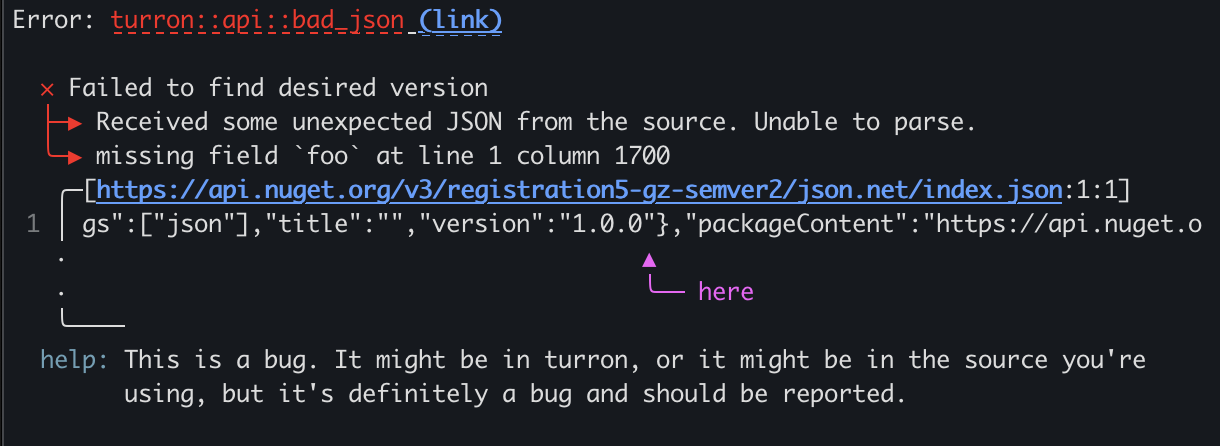
将 miette 添加到你的 Cargo.toml
🌐 Add miette to your Cargo.toml
[dependencies]
miette = { version = "5", features = ["fancy"] }
我们可以用 miette 封装我们的 Error,而不修改解析器中定义的 Result 类型:
🌐 We can wrap our Error with miette and not modify the Result type defined in our parser:
pub fn main() -> Result<()> {
    let source_code = "".to_string();
    let file_path = "test.js".to_string();
    let mut parser = Parser::new(&source_code);
    parser.parse().map_err(|error| {
        miette::Error::new(error).with_source_code(miette::NamedSource::new(file_path, source_code))
    })
}